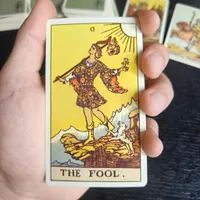
Short answer: the best Halloween tarot spreads are older than they look. Long before anyone shuffled a tarot deck on October 31, Scottish and Irish families spent Halloween night telling fortunes with kale stalks, nuts, apples, mirrors and bowls of water, and in 1785 the poet Robert Burns wrote down exactly how each game worked. Below, each of those nine games becomes a tarot spread, with positions and reading notes. If you only lay one tonight, make it the nine-card Three Dishes spread for the year ahead; for a relationship, use the five-card Two Nuts.
Most “Halloween tarot spreads” online are a pumpkin drawing with three generic positions. These are different: every spread here is a translation of a question people actually asked on Halloween, in the form they asked it. The old games were clever. They asked about the shape of a future partner, the temperament hidden in the heart of a stalk, whether two people burn quietly together. Those are excellent tarot positions.
I review tarot readers for a living, and the best readings I see always start with a well-shaped question. Halloween has been shaping good questions for three hundred years.
Why Halloween Was the Original Fortune-Telling Night
Burns opened his poem with a note explaining that he was recording “the principal charms and spells of that night, so big with prophecy to the peasantry in the west of Scotland.” He added that “the passion of prying into futurity makes a striking part of the history of human nature.” In other words: Halloween was the night for looking ahead, and most of the looking was about love.
There is a neat coincidence in the dates. Burns wrote “Halloween” in 1785 and published it in the Kilmarnock edition of 1786. In the very same years, in Paris, Antoine Court de Gébelin (1781) and the card reader Etteilla (from 1783) were turning the tarot, until then an Italian card game, into a tool for divination. Halloween fortune games and fortune-telling tarot grew up side by side, in different countries, in the same decade. This guide simply introduces them.
| Halloween game (recorded 1785–1786) | What it asked | Tarot spread below |
|---|---|---|
| Pulling the kail (kale) stalk | Who is coming, and what are they like? | The Kail Stalk (4 cards) |
| Burning the nuts | Will these two burn quietly together? | The Two Nuts (5 cards) |
| The apple and the mirror | What face is coming over my shoulder? | The Apple and the Mirror (3 cards) |
| The blue clue (ball of yarn) | Who, or what, holds the thread? | Wha Hauds? (4 cards) |
| Sowing hemp seed | What follows from what I’m sowing? | The Hemp Seed (4 cards) |
| Winnowing the corn | What work or station is coming? | The Winnowing (4 cards) |
| The three luggies (dishes) | Clear, muddied or empty: what’s ahead? | The Three Dishes (9 cards) |
| The wet sleeve where three lands meet | Which way will it turn? | Where Three Lands Meet (4 cards) |
| The barmbrack charms (Ireland) | Ring, coin, pea, stick or rag this year? | The Barmbrack (5 cards) |
How to use any spread here: shuffle while holding one clear question, lay the cards in the order given, read each card for its position first, then read the whole spread as a story. Burns’s games were played in company, laughing, by firelight, and that is still the best mood for them.
1. The Kail Stalk Spread (4 Cards): Who Is Coming?
The old game. Burns’s first footnote: young people went out “hand in hand, with eyes shut” and pulled the first kale plant they met. Big or little, straight or crooked, it foretold the size and shape of a future husband or wife. Earth clinging to the root meant a fortune, the taste of the heart of the stem showed “the natural temper and disposition,” and the stalks were hung above the door, where the names of the first visitors to walk under them gave the names in question. The Smithsonian has a lively history of kale as a Halloween matchmaker.
The spread. Shuffle with your eyes closed, as the game demands, and draw four cards in a vertical line, top to bottom, like a stalk.
- The stalk — the shape of the person or relationship coming toward you
- The earth on the root — what they bring with them (resources, stability, baggage)
- The heart of the stem — their temperament under the surface
- Over the door — how they are likely to enter your life
How to read it: card 3 is the reason this spread is better than most “future partner” spreads. The old game knew that the outside of the stalk and the taste of its heart can differ. A Knight of Wands in position 1 with the Four of Cups in position 3 describes someone exciting on arrival who needs time to warm up. Court cards in position 4 often point to a person who introduces you; Pentacles there suggest work or a practical setting.
2. The Two Nuts Spread (5 Cards): Will We Burn Quietly Together?
The old game. “Burning the nuts is a favorite charm,” Burns wrote. You named a nut for each sweetheart and laid them side by side in the fire, and “according as they burn quietly together, or start from beside one another, the course and issue of the courtship will be.” In much of northern England the night was simply called Nutcrack Night.
The spread. Lay two cards side by side, a third card across the middle beneath them, and two below that.
- The first nut — you in this relationship right now
- The second nut — them in this relationship right now
- The fire — what is heating things up (attraction, pressure, circumstance)
- Quiet or jumping — how the two of you handle that heat
- The embers — where it settles once the flare dies down
How to read it: compare cards 1 and 2 before anything else; similar suits sit quietly together, opposing elements (Wands and Cups, Swords and Pentacles) are where the crackle comes from. Card 4 is the heart of the old game, because the nuts that “start” apart are not the ones that get hot, they are the ones that cannot share the heat. Cups or Temperance in position 4 is the quietest burn of all. For more relationship layouts, see my love tarot spreads.
Want to play the original safely? Roast two named chestnuts on a tray in the oven, scored with a cross, and watch which way they split.
3. The Apple and the Mirror Spread (3 Cards): What Is Coming Over My Shoulder?
The old game. “Take a candle and go alone to a looking-glass; eat an apple before it,” Burns wrote, and some said you should comb your hair at the same time; the face of your future companion would appear in the glass, “as if peeping over your shoulder.” It is the ancestor of every Halloween mirror legend, and in the poem little Jenny is too frightened to try it alone.
The spread. Sit in front of a mirror by candlelight if you can. Lay three cards in a triangle: one at the top, two beneath.
- The face in the glass — how you see yourself right now
- Over your shoulder — what is approaching that you haven’t turned to face yet
- The candle — what lets you see it clearly
How to read it: this is a self-reflection spread disguised as a love spread, which is exactly what the mirror game was. If position 1 is harsh (the Five of Pentacles, the Nine of Swords) and position 2 is warm (the Sun, the Two of Cups, the Star), the reading is saying the good thing approaching is already closer than your self-image allows. Position 3 is advice: do that.
4. The “Wha Hauds?” Spread (4 Cards): Who, or What, Holds the Thread?
The old game. The bravest charm. You crept alone to the kiln in the dark, threw a ball (“clue”) of blue yarn into the kiln-pot, and wound it onto a new ball. Near the end, something would hold the thread. You demanded “Wha hauds?” (who holds?) and a voice from the pot answered with the full name of your future spouse.
The spread. Lay two cards side by side (the old ball and the new), then a third card above them, then a fourth on top.
- The old clue — the pattern you have been winding for a long time
- The new clue — what you are winding now, the change you’re making
- What holds — the thing that catches and tugs at the thread
- The answer from the pot — the name for it, the truth you’re ready to hear
How to read it: this is the spread for when something keeps pulling you back: a person, a habit, a fear, an old version of yourself. Card 3 is what holds; card 4 is what happens when you have the courage to ask. Major Arcana cards in position 3 suggest something large and fated that deserves respect rather than a fight; minor cards suggest something smaller than it feels. If this spread keeps landing on one person, my guide to soul ties is worth reading next.
5. The Hemp Seed Spread (4 Cards): What Follows From What I’m Sowing?
The old game. You slipped out unseen and sowed a handful of hemp seed, dragging something behind you to harrow it in and chanting “Hemp-seed, I saw thee,” then looked over your left shoulder to see your true love following, pulling the hemp. Some versions said “come after me and shaw thee”: show yourself.
The spread. Lay four cards in a row, left to right, the direction you’d walk a furrow.
- The seed — what you are putting into the world right now
- The harrowing — the effort it needs from you to take root
- What comes after — who or what is drawn to follow it
- Shaw thee — how it will show itself, the first visible sign
How to read it: the most hopeful spread in the set. The game is about something following you because of what you sowed, so it suits any question about attraction: a new relationship, clients, a creative project, a move. Aces in position 1 are a fresh, potent seed. Position 4 tells you what to watch for so that you recognise the result when it arrives.
6. The Winnowing Spread (4 Cards): What Work Is Coming?
The old game. Not every Halloween charm was about love. In the barn, with both doors open (taken off their hinges if possible, Burns noted, in case the visitor shut them), you went through the motions of winnowing corn three times with a sieve called a “wecht.” On the third time an apparition passed through the barn, showing not just a figure but “the appearance or retinue, marking the employment or station in life.”
The spread. Three cards in a row for the three passes, and a fourth across the doorway beneath them.
- The first pass — the chaff: what to let blow away in your working life
- The second pass — the grain that is left: the skills and strengths that stay
- The third pass — the figure that walks through: the work, role or station coming toward you
- Both doors open — what you need to keep open for it to arrive
How to read it: Pentacles in position 3 point to concrete jobs and money; Wands to a venture, a leap or self-employment; Swords to a role built on intellect or communication; Cups to work with people, care or creativity. Position 4 is practical advice, often about saying yes to something you’d normally close the door on. For a full career spread and the readers who handle these questions well, see career psychics.
7. The Three Dishes Spread (9 Cards): The Year Ahead
The old game. The three “luggies.” Three dishes were set on the hearth, one of clean water, one of foul water, one empty. A blindfolded person dipped the left hand: clean water foretold a marriage to a maiden or bachelor, foul water to a widow or widower, the empty dish no marriage at all. Crucially, Burns said it was “repeated three times, and every time the arrangement of the dishes is altered.”
The spread. Because the game was played three times with the dishes moved, this becomes a three-by-three grid. Columns are the dishes; rows are the three rounds.
| Clean water | Muddied water | Empty dish | |
|---|---|---|---|
| Round 1: the next three months | 1. What is clear | 2. What needs sorting | 3. Where there is room |
| Round 2: the middle of the year | 4. What is clear | 5. What needs sorting | 6. Where there is room |
| Round 3: by next Halloween | 7. What is clear | 8. What needs sorting | 9. Where there is room |
How to read it: read across each row first, then down each column. The empty dish no longer means “no marriage”; in a modern reading it is space, the room in your life for something that isn’t there yet, and it is often the most exciting column in the spread. Cards in the muddied column aren’t warnings so much as a to-do list. If the same suit dominates a whole row, that season of the year has a theme. This is the one spread here that also works as a classic Samhain spread: Samhain marked the turn from autumn into winter, the start of the dark half of the year, and a year-turn reading is the natural question for it. For the most famous ten-card alternative, see the Celtic Cross.
8. Where Three Lands Meet (4 Cards): Which Way Will It Turn?
The old game. A social spell for a group: you went to a south-running stream “where three lairds’ lands meet” and dipped your left shirt sleeve. At home you hung the wet sleeve before the fire, lay awake, and near midnight a figure of your future partner would come and turn the sleeve “as if to dry the other side of it.”
The spread. Three cards fanned in a curve, like three fields meeting at a stream, and one card laid across the centre.
- The first land — option one
- The second land — option two
- The third land — option three (or “neither”: the path you haven’t named)
- The hand that turns the sleeve — what will decide it, or the sign to wait for
How to read it: the decision spread. Most of us bring two options to a reading; the old charm insisted on three, and the third is often the one that turns out to matter. Position 4 is rarely “pick option two.” It’s usually a person, an event or an inner shift that tips the balance, which is exactly what the figure turning the sleeve represented. For a simpler version, try the three-card spreads.
9. The Barmbrack Spread (5 Cards): Ring, Coin, Pea, Stick or Rag
The old game. In Ireland, the Halloween fortune came baked into the báirín breac, the speckled fruit loaf. Whoever found a charm in their slice had their year told: the ring meant marriage within the year, the coin good fortune, the pea no marriage that year, the stick quarrels, and the scrap of cloth bad luck or poverty, as the Government of Ireland’s own barmbrack guide lists them. Shop-bought bracks today usually contain only a ring.
The spread. Cut your deck into five small piles, like slices, and take the top card of each.
- The ring — love and commitment this year
- The coin — money and good fortune this year
- The pea — what is waiting, not yet ready to sprout
- The stick — the friction to handle with care
- The rag — what needs mending
How to read it: the old charms only gave you one slice; this spread gives you the whole loaf, so even the stick and the rag become useful. Position 4 names where to be patient this year; position 5 names what, once repaired, will make everything else run better. A reversed card in the ring position often means love that needs one honest conversation, not love that’s missing.
Which Halloween Spread for Which Question?
| Your question | Spread | Cards |
|---|---|---|
| ”What does the year ahead hold?” | The Three Dishes | 9 |
| ”Is this relationship going to work?” | The Two Nuts | 5 |
| ”Who is my next partner going to be?” | The Kail Stalk | 4 |
| ”Why can’t I let this go?” | Wha Hauds? | 4 |
| ”Will my effort pay off?” | The Hemp Seed | 4 |
| ”What’s next in my career?” | The Winnowing | 4 |
| ”Which option should I choose?” | Where Three Lands Meet | 4 |
| ”Quick yearly forecast for a party” | The Barmbrack | 5 |
| ”How do I really see myself?” | The Apple and the Mirror | 3 |
The “Scary” Cards Are Halloween’s Best Cards
Halloween is the night people most often pull a card that looks frightening and panic. Here is what those cards actually say, and why they fit the season.
| Card | Looks like | Actually means | Why it suits Halloween |
|---|---|---|---|
| Death (XIII) | Literal death | An ending that clears room for a new chapter | Halloween was the hinge between the old season and the new |
| The Moon (XVIII) | Danger in the dark | Intuition, dreams, a situation not yet fully visible | The night of mirrors, candles and half-seen faces |
| The Tower (XVI) | Disaster | A sudden truth that frees you from something false | The shock that sweeps away a pretence |
| The Devil (XV) | Evil | Attachments and habits that hold you, and the chain you can lift off | ”Wha hauds?” in card form; see my Devil card guide |
| Ten of Swords | Ruin | Rock bottom, which means the only direction left is up | The darkest point before the turn |
| Five of Cups | Grief | Mourning what’s spilled while two full cups still stand behind you | Allhallowtide was a season of remembering the dead with love |
| The High Priestess (II) | Secrets | Inner knowing, the veil between what’s seen and unseen | The card most associated with the “thin veil” |
The Halloween card, if you want one: most readers would choose Death for Samhain’s ending-and-beginning or the High Priestess for the veil. For the full deck, see my beginner’s guide to tarot card meanings.
How to Run a Halloween Tarot Night (the Way Burns’s Party Did)
The poem describes a party: friends gathered at a farmhouse, laughing at each other’s charms, a bit of courage needed for the scarier ones, and a hot supper at the end (sowens with butter, Burns notes, “is always the Halloween Supper”). That is still the best format.
- Give every guest one spread from the menu above, chosen by their question, not by you. The old games were opt-in.
- Play one “dare” spread by candlelight. The Apple and the Mirror or Wha Hauds? are the traditional brave ones.
- Read for each other, not just for yourself. Fresh eyes notice what you miss.
- Write the readings down and seal them in envelopes marked “Open next Halloween.” Re-reading them a year later is the most fun part, and the most honest test of any spread.
- Keep it kind. The original games were matchmaking fun. Use the light versions of every card meaning when you read for friends.
Halloween 2026: A Night for Revisiting
This Halloween falls inside an unusual stretch of sky. Venus has been retrograde since October 3 and Mercury since October 24, and both turn direct on November 13, a double retrograde astrologers associate with the past returning: exes, old friends, unfinished conversations. If your Two Nuts or Wha Hauds? spread keeps pointing at someone from before, that’s a very 2026 reading. More in my guide to Venus retrograde and exes and the Mercury retrograde dates. For the history behind Halloween’s “thin veil,” see is the veil thinner on Halloween?
If you would rather have an experienced reader lay a Halloween spread for you, my Halloween tarot reading guide has six tarot readers to book tonight, with what a first reading costs; best tarot reading sites compares the platforms, and best tarot readers on Kasamba ranks tested readers. You can also bring any of these spreads to a reading: asking for “the Three Dishes spread” gives a reader a clear structure and you a clear answer.
FAQ
What is the best tarot spread for Halloween?
For the year ahead, the nine-card Three Dishes spread, from the old Scottish game of the three luggies. For a relationship, the five-card Two Nuts spread, from the custom of burning named nuts in pairs.
Did people really tell fortunes on Halloween?
Yes. In eighteenth- and nineteenth-century Scotland and Ireland, Halloween was the year’s great night for fortune games, mostly about love. Burns’s 1785 poem and his own footnotes describe kale stalks, nuts, the apple and mirror, hemp seed, the three dishes and more. Historians generally see them as social games rather than solemn magic.
What is a Samhain tarot spread?
A year-turn reading: what to release from the year ending, what to carry forward and what the dark half of the year asks of you. The Three Dishes and Barmbrack spreads both work, and both come from real Halloween customs.
Is it bad to pull the Death card on Halloween?
No. The Death card almost never means physical death. It is an ending that makes room for a new chapter, which is exactly what Halloween, the old hinge of the season, was about.
Is Halloween a good time for a tarot reading?
Many readers treat it as one, because it has been a night for looking ahead for centuries. In 2026 it also falls inside the Venus and Mercury double retrograde, so questions about the past and old relationships feel especially timely.
Can I use these spreads with oracle or Lenormand cards?
Yes. The positions work with any deck. Lenormand’s smaller, more literal cards suit the Kail Stalk and Barmbrack spreads especially well; see Lenormand vs tarot for the differences.
Sources
- Burns, R. (1786). “Halloween,” with the author’s notes, in Poems, Chiefly in the Scottish Dialect (Kilmarnock). Text and footnotes via Project Gutenberg, The Complete Works of Robert Burns.
- Smithsonian Magazine. “The Halloween Tradition Best Left Dead: Kale as Matchmaker.” smithsonianmag.com
- Government of Ireland, Ireland.ie. “Báirín breac: a traditional Irish Halloween recipe” (charms and meanings). ireland.ie
- University of St Andrews Special Collections. “‘Alhallow Evin’ in Scotland.” st-andrews.ac.uk
- Hutton, R. (1996). The Stations of the Sun: A History of the Ritual Year in Britain. Oxford University Press (chapters on Halloween and Samhain).
- Court de Gébelin, A. (1781). Le Monde primitif, vol. 8 (the essay that first presented tarot as an ancient divinatory book); Etteilla (1783–1785), Manière de se récréer avec le jeu de cartes nommées tarots.
How to get a tarot reading by phone in 2026: what a telephone tarot reading costs (phone-rate medians of $7.99/min on Kasamba, $5.99 on Purple Garden and $6.26 on Keen across 191 audited tarot readers), why Keen is the cheapest place to call, five tarot readers whose call rate is the same as or lower than their chat rate (from $2.25/min), what a 10, 20 or 30-minute first call costs with welcome offers, and how to prepare so the cards answer your question.
Read the guide →Still weighing it up? The fastest way to know if a reading clicks is to try one — 3 free minutes + 50% off for new clients.
Free to join · 3 free minutes on your first reading · No subscription
Ready to get your reading?
Pick the one that fits your question — every link is an independent recommendation.
3 free minutes + 50% off
Permanent chat transcripts & 3 free minutes on your first reading — safest for testing relationship specialists.
Claim 3 Free Min + 50% Off →Claim 3 Free Min →
$30 free credit
Mandatory video intros & a public outcomes ledger. The most accessible entry price.
Claim $30 Credit →Claim $30 Credit →
5 free minutes
Your first 5 minutes are credited back after the first reading, and a disappointing session can earn up to 10 minutes back.
Claim 5 Free Min →Claim 5 Free Min →Offer is for new customers only. Used Kasamba before? Try Purple Garden — see their top tarot readers →
Eastern Alignment is reader-supported. If you sign up through a link, we may earn a commission — at no extra cost to you. This never influences my ratings.