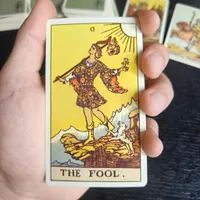

The short answer: Lenormand is a 36-card fortune-telling deck in which each card shows one simple everyday image (the Rider, the House, the Ring, the Heart) with a small playing-card inset. Unlike tarot’s 78 symbolic cards, Lenormand cards are read together, like words in a sentence: Rider + Heart = news about love. That makes Lenormand concrete and event-focused, while tarot is better at feelings, motivations and the bigger story. The deck descends from a parlour game designed in Nuremberg around 1799, and was named after the famous French fortune teller Marie Anne Lenormand only after her death.
Lenormand vs Tarot at a Glance
| Lenormand | Tarot | |
|---|---|---|
| Number of cards | 36 | 78 (22 Major + 56 Minor Arcana) |
| Images | One simple object or figure per card | Detailed symbolic scenes |
| How cards are read | In combination: pairs, lines and grids | Each card has its own meaning, shaped by its position |
| Reversed cards | Not usually used | Commonly used |
| Best at | Concrete events, practical outcomes, “what will happen” | Inner states, motivations, advice, “why” |
| Tone | Direct, matter-of-fact | Reflective, layered |
| Signature spread | Grand Tableau (all 36 cards) | Celtic Cross (10 cards) |
| Origin | Germany, c. 1799 (Hechtel’s Game of Hope) | Italy, 15th century (as a card game); divination from the 18th century |
Which should you choose? If your question is “Will he get in touch?” or “Will I get the job?”, Lenormand’s directness suits it. If it’s “Why do I keep ending up here?” or “What should I do?”, tarot gives more to work with. Plenty of readers combine them: Lenormand for the event, tarot for the advice.
Where the Lenormand Deck Came From
The deck is older than its name. In about 1799, Johann Kaspar Hechtel, a Nuremberg businessman and designer of parlour games, published Das Spiel der Hoffnung (“The Game of Hope”): 36 illustrated cards laid out in a grid for a race-style game of chance, with an option to use them for fortune telling. Hechtel died in December 1799.
Marie Anne Lenormand (1772–1843) was the most celebrated fortune teller in Paris during the Napoleonic era, famous for her clients and her books. After her death, publishers attached her name to fortune-telling decks to sell them, and the 36-card design became the “Petit Lenormand”. Historians of cartomancy note that she had no hand in creating it; she reportedly read with ordinary playing cards.
Over the 19th century the card names, their order and their playing-card insets became standardised, which is why almost every Lenormand deck today uses the same 36 cards in the same order.
All 36 Lenormand Card Meanings
| # | Card | Inset | Core meaning | In a love reading |
|---|---|---|---|---|
| 1 | Rider | 9♥ | News, a message, a visitor, speed | News from or about someone; a new admirer arriving |
| 2 | Clover | 6♦ | Small luck, a brief opportunity | A lucky, light moment; a chance worth taking |
| 3 | Ship | 10♠ | Travel, distance, moving on | Long distance; someone far away; a change of direction |
| 4 | House | K♥ | Home, family, stability | Settling down; a home together; family matters |
| 5 | Tree | 7♥ | Health, growth, roots, slow time | Slow, deep-rooted growth; a long-standing bond |
| 6 | Clouds | K♣ | Confusion, uncertainty, temporary trouble | Mixed signals; unclear feelings that will pass |
| 7 | Snake | Q♣ | Complication, a detour, a clever woman | A complicated situation; a rival; take the longer route |
| 8 | Coffin | 9♦ | Endings, closure, rest | A chapter closing; clearing space for something new |
| 9 | Bouquet | Q♠ | Gifts, appreciation, pleasant surprise | Compliments, flowers, an invitation; feeling valued |
| 10 | Scythe | J♦ | Sudden decision, a cut, swift change | A quick, decisive moment |
| 11 | Whip (Broom) | J♣ | Repetition, arguments, passion | Recurring arguments, or strong physical chemistry |
| 12 | Birds | 7♦ | Conversation, chatter, nerves | Talking things through; phone calls and texts |
| 13 | Child | J♠ | New beginnings, innocence, small | A new, fresh start; a child; something just beginning |
| 14 | Fox | 9♣ | Caution, cleverness, work | Look closely; also self-interest and smart strategy |
| 15 | Bear | 10♣ | Strength, protection, money, a strong person | A protective partner; finances in the relationship |
| 16 | Stars | 6♥ | Hope, guidance, clarity | Hope, clear direction, things lining up |
| 17 | Stork | Q♥ | Change, improvement, moving | A positive change; a relationship moving forward |
| 18 | Dog | 10♥ | Loyalty, friendship, trust | A loyal partner or friend |
| 19 | Tower | 6♠ | Institutions, independence, boundaries | Independence; a partner who keeps their distance; formal steps |
| 20 | Garden | 8♠ | Social life, public, events | Meeting someone at an event or online; being seen together |
| 21 | Mountain | 8♣ | Obstacles, delay | Delays or distance to overcome, patience needed |
| 22 | Crossroads (Paths) | Q♦ | Choices, options | A choice between paths, or between people |
| 23 | Mice | 7♣ | Gradual loss, worry, erosion | Small stresses wearing things down; something to tend to |
| 24 | Heart | J♥ | Love, affection, feelings | Love itself; genuine feelings |
| 25 | Ring | A♣ | Commitment, contracts, cycles | Commitment, engagement, an agreement |
| 26 | Book | 10♦ | Secrets, knowledge, the unknown | Something not yet revealed; learning about each other |
| 27 | Letter | 7♠ | Written message, documents | A text, letter or message; written words |
| 28 | Man (Gentleman) | A♥ | The querent (if male) or the man in question | Him |
| 29 | Woman (Lady) | A♠ | The querent (if female) or the woman in question | Her |
| 30 | Lily | K♠ | Maturity, peace, sensuality, time | A mature, peaceful bond; intimacy; an older partner |
| 31 | Sun | A♦ | Success, energy, warmth | Happiness and success; a clear “yes” energy |
| 32 | Moon | 8♥ | Emotions, recognition, intuition | Romance, deep feelings; being noticed |
| 33 | Key | 8♦ | Certainty, solutions, importance | It’s meant to be; the answer; a breakthrough |
| 34 | Fish | K♦ | Money, business, abundance, flow | Generosity; finances; freedom |
| 35 | Anchor | 9♠ | Stability, staying, long term | A lasting relationship; staying put |
| 36 | Cross | 6♣ | Burden, duty, faith, destiny | A meaningful commitment; a lesson; faith through a hard patch |
Meanings follow the standard modern “Petit Lenormand” tradition. Individual readers vary in nuance, especially on the Man and Woman cards, which many readers now assign by role rather than gender.
How to Read Lenormand Cards in Combination
Lenormand works like a language: single cards are words, and combinations make sentences.
Pairs: subject + description
Read the first card as the subject and the second as describing it, like a noun and an adjective:
| Pair | Reading |
|---|---|
| Rider + Heart | News about love; a romantic message |
| Heart + Rider | Love that arrives quickly |
| Ring + Anchor | A lasting commitment |
| Letter + Birds | A conversation by text or message |
| Key + Ring | The commitment is certain |
| Clouds + Sun | Confusion clears; things brighten |
| Mountain + Stork | A delay, then positive change |
| Ship + House | Coming home; moving in |
Lines of three or five
Read left to right, each card adding to the one before. Man + Birds + Ring might read “he wants to talk about commitment”. In a five-card line, the middle card is the heart of the matter, with the cards on each side describing what leads into it and what follows.
The Grand Tableau
The Grand Tableau lays out all 36 cards, usually in four rows of eight plus a final row of four. Each position is a “house” named after a card (position 1 is the house of the Rider, position 24 the house of the Heart, and so on). The reader looks at:
- Where your significator (Man or Woman card) falls, and the cards touching it
- What lands in key houses, such as the Heart, the Ring or the Key
- Lines and diagonals running through your significator
- Cards ahead of the significator (often the future) and behind it (the past)
A Grand Tableau is the most detailed reading Lenormand offers, usually 30 minutes or more with a reader.
Getting a Lenormand Reading Online
Lenormand is a specialist skill: most online readers use tarot, and a smaller number also read Lenormand. In our audit of 242 advisors on Kasamba, Purple Garden and Keen, readers who name Lenormand in their profiles include:
- Tarot With Meg (Keen, $4.75/min): reads Rider-Waite-Smith tarot as her main deck, with Lenormand for practical, everyday questions and Hellenistic astrology for timing.
- Chloe Has Your Love Insights (Keen, $2.58/min): a 25-year professional reader of tarot, Lenormand and playing cards, with 35,997 readings since 2015; direct about love questions.
- PAT Angels Messenger (Kasamba, chat $6.99/min): reads in English or Spanish with seven decks, including Lenormand and the Tarot de Marseille, choosing the spread by question type; 25,741 readings since 2007.
Tips for a Lenormand reading:
- Ask a concrete question. “Will we reconnect before summer?” suits Lenormand better than “What’s my path?”
- Ask the reader to name the cards. Like tarot, Lenormand is card-anchored, and you can look up every pair afterwards with the table above.
- Use chat for a record. A chat reading leaves a transcript of every combination.
- Pair it with tarot if you want advice. Many readers will do a quick tarot pull on “what should I do?” after the Lenormand answer.
Most tarot readers can also help with Lenormand-style yes-or-no questions; see our best online tarot reading sites for the strongest card readers on each platform, and best tarot readers on Keen for oracle and playing-card specialists.
Frequently Asked Questions
What are Lenormand cards?
A 36-card fortune-telling deck in which each card shows one everyday image with a playing-card inset. Cards are read in pairs and lines like words in a sentence, giving concrete, practical answers. The deck descends from Johann Kaspar Hechtel’s Game of Hope (Nuremberg, c. 1799).
What is the difference between Lenormand and tarot?
Tarot (78 cards) is symbolic and strong on feelings, motivations and advice; each card can stand alone. Lenormand (36 cards) is concrete and strong on events and outcomes; cards are combined, and reversals aren’t usually used.
Was the Lenormand deck created by Marie Lenormand?
No. Marie Anne Lenormand (1772–1843) was a famous French fortune teller, but the deck was modelled on Hechtel’s Game of Hope and named after her by publishers after her death. She reportedly read with ordinary playing cards.
How do you read Lenormand card pairs?
The first card is the subject, the second describes it. Rider + Heart = news about love; Heart + Rider = love arriving quickly. In longer lines each card modifies the one before.
What is a Grand Tableau?
A spread of all 36 cards (usually four rows of eight plus four). Each position is a “house” named after a card; the reader looks at where your significator falls, what surrounds it, and what lands in key houses.
Is Lenormand more accurate than tarot?
They answer different questions. Lenormand gives direct, event-focused answers; tarot is better at the why and what to do. Many readers use both.
Related Guides
- Tarot card meanings for beginners
- Yes or no tarot cheat sheet
- Love tarot spreads
- Best online tarot reading sites
- Psychic vs tarot vs astrology
Sources
- Johann Kaspar Hechtel and Das Spiel der Hoffnung (c. 1799). Wikipedia; Horniman Museum, divination cards object 1970.18. horniman.ac.uk
- Marie Anne Lenormand (1772–1843). Wikipedia
- Etteilla.org. Petit Lenormand family history. etteilla.org
A ranking of the six best tarot readers on Kasamba in 2026, built on tarot's structural advantage — every claim is anchored to a card you can look up. Includes a reader whose client kept a five-year prediction log, Kasamba's own former horoscope writer, and the fastest draw on the platform.
Read the guide →Still weighing it up? The fastest way to know if a reading clicks is to try one — 3 free minutes + 50% off for new clients.
Free to join · 3 free minutes on your first reading · No subscription
Ready to get your reading?
Pick the one that fits your question — every link is an independent recommendation.
3 free minutes + 50% off
Permanent chat transcripts & 3 free minutes on your first reading — safest for testing relationship specialists.
Claim 3 Free Min + 50% Off →Claim 3 Free Min →
$30 free credit
Mandatory video intros & a public outcomes ledger. The most accessible entry price.
Claim $30 Credit →Claim $30 Credit →
5 free minutes
Your first 5 minutes are credited back after the first reading, and a disappointing session can earn up to 10 minutes back.
Claim 5 Free Min →Claim 5 Free Min →Eastern Alignment is reader-supported. If you sign up through a link, we may earn a commission — at no extra cost to you. This never influences my ratings.