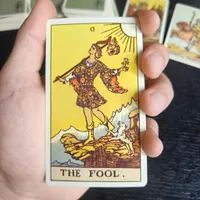

The short answer: tarot is a structured system of 78 cards: 22 Major Arcana for big life themes and 56 Minor Arcana in four suits (Cups, Pentacles, Swords, Wands) for everyday situations. Every tarot deck follows that structure, so card meanings are shared across decks and readers. Oracle cards have no fixed structure: a deck can have 36 cards or 80, built around any theme (angels, goddesses, animals, affirmations), with meanings set by its own guidebook. Tarot is better for detailed, story-like answers about situations and timing; oracle cards are better for a clear message, theme or encouragement. Many readers use both: a tarot spread for the detail and an oracle card for the overall message.
| Tarot | Oracle cards | |
|---|---|---|
| Number of cards | Always 78 | Any number (commonly 36–60) |
| Structure | 22 Major Arcana + 56 Minor Arcana in 4 suits, with court cards | None fixed; each deck has its own |
| Meanings | Shared tradition across decks | Set by each deck’s guidebook |
| Typical messages | Detailed: people, events, stages, obstacles | Direct: a theme, lesson or affirmation |
| Reversals | Commonly used | Depends on the deck |
| Learning curve | Steeper; deep and transferable | Gentle; read the card and the guidebook |
| Best for | Specific situations, relationships, timing, decisions | Daily guidance, reflection, spiritual messages |
What Is Tarot?
Tarot began in 15th-century Italy as a card game (tarocchi), and became a tool for divination in the late 18th century, most famously through French writers such as Antoine Court de Gébelin. The best-known modern deck, the Rider–Waite–Smith (1909, illustrated by Pamela Colman Smith), gave every card a full illustrated scene and remains the template for most decks today.
The 78 cards break down like this:
| Part | Cards | What it covers |
|---|---|---|
| Major Arcana | 22 (The Fool to The World) | Life lessons and turning points |
| Cups | 14 | Emotions, love, relationships |
| Pentacles | 14 | Money, work, home, the body |
| Swords | 14 | Thoughts, decisions, conflict, truth |
| Wands | 14 | Energy, ambition, creativity, action |
Each suit has Ace to Ten plus four court cards (Page, Knight, Queen, King), which often represent people. Because the structure is shared, a reader who knows one tarot deck can read almost any other. Full guide: tarot card meanings for beginners.
What Are Oracle Cards?
Oracle decks are a freer, mostly modern form of cartomancy. Each deck is its own system: a creator chooses the theme, the number of cards, the artwork and the meanings. Many cards include a keyword or message printed on the card, such as “Trust”, “Release” or “New Beginnings”, which makes them easy to read straight away.
Popular oracle themes include angels and guides, goddesses, animals and spirit animals, the moon and nature, crystals, affirmations and self-love, and cultural or mythological traditions such as Egyptian imagery.
Is Lenormand an oracle deck? Broadly, yes: it’s a non-tarot deck, but with a fixed 36-card structure and a strong reading tradition, it sits between tarot and free-form oracle decks. See Lenormand vs tarot.
How the Readings Feel Different
A tarot reading builds a story. Cards are placed in positions (past, present, future; you, them, the relationship) and their suits, numbers and imagery interact. You’ll get detail: who’s involved, what’s in the way, what stage things are at.
An oracle reading delivers a message. A single card or a short spread tells you the theme or lesson of the moment, often in uplifting, empowering language.
| Your question | Tarot answer style | Oracle answer style |
|---|---|---|
| ”Will we get back together?” | Shows the dynamic, obstacles and likely direction | Offers the lesson or energy to focus on, such as “Patience" |
| "What should I focus on this week?” | A spread showing several areas | One clear theme card |
| ”Should I take the job?” | Compares paths, shows outcomes | Gives the guiding message for the decision |
| ”What do my guides want me to know?” | Possible, but less direct | Exactly what many oracle decks are designed for |
Which Should You Start With?
| Choose tarot if you… | Choose oracle cards if you… |
|---|---|
| Want detailed answers about specific situations | Want daily inspiration and reflection |
| Enjoy learning a system in depth | Want to start reading immediately |
| Like stories, symbols and structure | Like affirmations and positive messages |
| Want skills that transfer to any deck | Are drawn to a particular theme or artwork |
Many people begin with an oracle deck for daily draws and add tarot when they want more detail, or the reverse.
Using Tarot and Oracle Cards Together
Readers often combine them:
- Oracle as the theme card: draw one oracle card first for the overall energy, then lay a tarot spread for the details.
- Oracle as the clarifier: if a tarot spread feels unclear, an oracle card can sum up its message.
- Oracle as the closing advice: end a tarot reading with an oracle card for “What do I most need to remember?”
Readers Who Use Oracle Cards
Many online readers work with tarot, oracle cards or both; profiles usually list their tools. Readers we’ve reviewed with distinctive card styles:
- Krys Britton (Keen, $2.25/min): Egyptian Oracle Cards as her signature tool, rare on any major platform; 49,000+ readings since 2010, known for concrete, actionable answers.
- Miss Bathsheba (Kasamba, $4.99/min): a second-generation tarot specialist; 71,618 readings.
- Tarot With Meg (Keen, $4.75/min): Rider–Waite–Smith tarot plus inclusive decks.
- Psychic Kayla (Purple Garden): energy first, tools second; a perfect 5.0 across 39,760 readings.
If a specific deck matters to you, ask the reader at the start of the session. More: best online tarot reading sites.
Frequently Asked Questions
What is the difference between tarot and oracle cards?
Tarot always has 78 cards with a fixed structure (22 Major Arcana and 56 Minor Arcana in four suits) and shared meanings across decks. Oracle cards have any number of cards and no fixed structure; each deck has its own theme and guidebook.
Are oracle cards easier than tarot?
Usually, yes. Many oracle cards carry a printed keyword or message and come with a guidebook, so you can read them immediately. Tarot takes longer to learn, but its shared system gives more detailed readings and works with any deck.
Can oracle cards predict the future?
Oracle cards are mainly used for guidance, themes and messages rather than detailed predictions. Tarot spreads with timeline positions (such as Past – Present – Future) are more commonly used for questions about what’s coming.
Can you use tarot and oracle cards together?
Yes. A common method is to draw an oracle card for the overall theme and a tarot spread for the details, or to use an oracle card as a clarifier when a tarot spread is unclear.
Is Lenormand tarot or oracle?
Lenormand is a 36-card non-tarot deck, so it’s usually grouped with oracle cards, but it has a fixed structure and reading tradition of its own. See Lenormand vs tarot.
Should a beginner buy tarot or oracle cards first?
If you want quick daily guidance, start with an oracle deck whose art you love. If you want to learn a system that gives detailed readings, start with a Rider–Waite–Smith-style tarot deck.
Related Guides
- Tarot card meanings for beginners
- How to read tarot cards
- Lenormand vs tarot
- Three-card tarot spreads
- Psychic vs medium vs tarot reader
The eight best tarot and card readers on Keen in 2026, chosen from our audit of 49 Keen advisors: what each reader's method is, what they cost with Keen's 5-minutes-for-$1 offer, and which one fits your question.
Read the guide →Still weighing it up? The fastest way to know if a reading clicks is to try one — 3 free minutes + 50% off for new clients.
Free to join · 3 free minutes on your first reading · No subscription
Ready to get your reading?
Pick the one that fits your question — every link is an independent recommendation.
3 free minutes + 50% off
Permanent chat transcripts & 3 free minutes on your first reading — safest for testing relationship specialists.
Claim 3 Free Min + 50% Off →Claim 3 Free Min →
$30 free credit
Mandatory video intros & a public outcomes ledger. The most accessible entry price.
Claim $30 Credit →Claim $30 Credit →
5 free minutes
Your first 5 minutes are credited back after the first reading, and a disappointing session can earn up to 10 minutes back.
Claim 5 Free Min →Claim 5 Free Min →Eastern Alignment is reader-supported. If you sign up through a link, we may earn a commission — at no extra cost to you. This never influences my ratings.