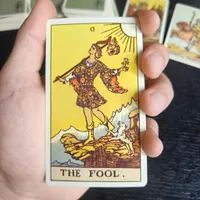

The short answer: a 5-card tarot spread sits between a quick three-card reading and the ten-card Celtic Cross: enough cards to show what’s happening, why, and where it’s heading, but still quick to read in 15 to 20 minutes. The most popular version is the five-card cross: (1) the present, (2) the past, (3) the future, (4) the root of the situation, and (5) the potential outcome. Below are eight five-card layouts, including spreads for love, an ex, a decision and your career, with a worked example.
| Spread | Positions | Best for |
|---|---|---|
| Five-card cross | Present · Past · Future · Root · Potential | Any situation |
| Extended past–present–future | Past · Present · Hidden influence · Advice · Outcome | Seeing what you’re missing |
| Love spread | You · Them · Connection · Challenge · Where it’s heading | A relationship or crush |
| Will they come back? | Why it ended · Their feelings now · Your feelings · What’s needed · Likely outcome | An ex |
| Decision spread | The situation · Option A · Option B · What to know · Advice | Choosing between two paths |
| Career spread | Where you are · Strengths · Obstacle · Action · Outcome | Work and money |
| Five elements | Earth · Water · Air · Fire · Spirit | A whole-life check-in |
| Five-card yes or no | Five cards, majority decides | A yes-or-no with nuance |
Why Five Cards Work So Well
Three cards tell a story in one line. Five cards add depth: the cause underneath the situation and the advice or obstacle alongside it. That makes five cards ideal when you want to understand a situation, not just get a verdict, without committing to a 30-minute Celtic Cross.
Five is also a natural number in tarot: in the Minor Arcana, the fives are the cards of challenge and change, the point where a story gets interesting. A five-card spread gives a challenge or a cause its own place on the table.
8 Five-Card Tarot Spreads
1. The Five-Card Cross (the classic)
Lay the cards in a cross: one in the centre, one on each side, one above and one below.
        [5]
   [2]  [1]  [3]
[4]- Present — the heart of the situation
- Past — what led here
- Future — what’s coming next
- Root — the cause or foundation underneath it all
- Potential — the best outcome available
Read it in two lines: the horizontal (past → present → future) is the timeline; the vertical (root → present → potential) is the depth. Where the lines cross, in card 1, is what you’re living now.
2. The Extended Past–Present–Future
A three-card spread with two cards that make it far more useful:
- Past
- Present
- Hidden influence — what you can’t see or aren’t admitting
- Advice — what to do
- Likely outcome — where things go if you follow the advice
3. The Five-Card Love Spread
- You — how you’re showing up in the relationship
- Them — how they’re showing up
- The connection — the energy between you
- The challenge — what’s testing it
- Where it’s heading — the next chapter
Tip: compare cards 1 and 2. Matching suits (two Cups, say) suggest you want the same things; clashing suits (Swords against Cups) suggest one of you is thinking while the other is feeling.
4. Will They Come Back? (Ex Spread)
- Why it ended — the real reason underneath
- Their feelings now
- Your feelings now
- What’s needed — for a reunion, or for you to move on
- Likely outcome
If card 5 is heavy (the Tower, Ten of Swords, Five of Cups), read card 4 as advice for your own healing. More ex and situationship layouts are in our love tarot spreads.
5. The Decision Spread
   [2]       [3]
        [1]
[4] [5]- The situation — what you’re really deciding
- Option A — what this path brings
- Option B — what that path brings
- What you need to know — the factor you’re overlooking
- Advice — how to choose
6. The Career Spread
- Where you are — your current work situation
- Your strengths — what you bring
- The obstacle — what’s holding you back
- Action — the next step to take
- Outcome — where it leads in the next few months
7. The Five Elements Check-In
- Earth — body, home, money
- Water — feelings and relationships
- Air — thoughts and communication
- Fire — energy, passion, ambition
- Spirit — your inner self and sense of purpose
A lovely monthly or new-year spread. Look for the element whose card looks weakest: that’s where to put your attention.
8. The Five-Card Yes or No
Draw five cards. Count upright cards as yes and reversed as no (or use each card’s yes/no value from our yes or no tarot cheat sheet). The majority decides: 5–0 or 4–1 is a clear answer; 3–2 is “yes, but”, and the minority cards tell you the “but”.
How to Read a Five-Card Spread: Step by Step
- Choose the spread before you shuffle. Decide what each position means first, so the cards answer your question, not one you invent afterwards.
- Lay all five cards face down, then turn them in order. Notice your first reaction to each.
- Read each card in its position. “The Three of Swords in the past” means a hurt that has happened; “in the future” is a warning you can act on.
- Look for patterns. Several Major Arcana = big life themes. One suit dominating = the area of life involved. Many reversals = blocked or internal energy.
- Read the spread as a story. How does card 1 lead to card 5? What changes?
- Sum it up in one sentence. If you can’t, draw one clarifying card for the position that feels least clear.
A Worked Example: The Five-Card Love Spread
Question: “What’s going on between me and Alex, and where is it heading?”
| # | Position | Card | Reading |
|---|---|---|---|
| 1 | You | Queen of Cups | Caring and intuitive, open-hearted |
| 2 | Them | Knight of Pentacles | Steady, reliable, slow to move |
| 3 | The connection | Two of Cups | Genuine, mutual attraction |
| 4 | The challenge | Seven of Swords | Something unspoken, or overthinking |
| 5 | Where it’s heading | Ten of Cups | Lasting emotional happiness |
The story: you’re bringing warmth and feeling (1); Alex shows love through reliability, not words (2). The attraction is real and mutual (3). The challenge (4) is what’s not being said: you may be reading too much into Alex’s slow pace, or something hasn’t been talked about openly. The outcome (5) is one of the happiest cards in the deck. The message: say what you’re thinking, give Alex’s steady style time, and this has real long-term promise.
Five Cards vs Three Cards vs the Celtic Cross
| Three cards | Five cards | Celtic Cross (10) | |
|---|---|---|---|
| Time to read | 5–15 minutes | 15–20 minutes | 20–40 minutes |
| Best for | One clear question | Understanding a situation | The full picture of something complicated |
| Shows the cause? | Rarely | Yes (root or hidden influence) | Yes, in detail |
| Shows advice? | If you make it a position | Usually | Indirectly |
| Good for beginners? | Yes | Yes | After some practice |
Start with three-card spreads or a single-card reading, move to five, and graduate to the Celtic Cross when you want the whole picture.
Getting a Five-Card Reading From a Tarot Reader
A five-card spread fits neatly into a 15-minute reading, which is where welcome offers stretch furthest: at a typical $4.99/min, 15 minutes costs $29.94 on Kasamba (3 free minutes, then half price), $44.85 on Purple Garden (after the $30 credit) and $50.90 on Keen (5 minutes for $1). Tarot readers we’ve reviewed who lay out structured spreads:
- Simone Guiding Vision (Kasamba, $3.49/min chat): calm, structured tarot on love, career and dreams.
- Bridges Light (Purple Garden, $4.99/min chat): love, career and money answered with structure and a plan.
- Master Sher (Keen, $4.29/min): honest, structured tarot on relationships and decisions.
Ask the reader for the spread by name (“Could you do a five-card love spread?”); most are happy to. For prices across every type of reading, see how much a tarot reading costs.
Frequently Asked Questions
What is a 5-card tarot spread?
A layout of five cards in named positions. The classic five-card cross covers the present, past, future, the root of the situation and the potential outcome. Other versions are designed for love, an ex, decisions, career or a whole-life check-in.
How do you read a five-card tarot spread?
Choose the positions before you shuffle, read each card in the meaning of its position, look for patterns (Major Arcana, a dominant suit, reversals), then read the five cards as one story and sum up the answer in a sentence.
What is the best five-card spread for love?
You · Them · The connection · The challenge · Where it’s heading. It shows how each of you is showing up, what’s between you, what’s testing it and the next chapter.
What does the five-card cross show?
The present (centre), past (left), future (right), root or foundation (below) and potential outcome (above). The horizontal line is the timeline; the vertical line shows the depth of the situation.
Can I use five cards for a yes or no question?
Yes. Draw five cards and let the majority decide, counting upright as yes and reversed as no, or using each card’s yes/no value. Four or five in agreement is a clear answer; three to two means “yes, but” or “no, unless”.
How long does a five-card tarot reading take?
About 15 to 20 minutes, with a reader or on your own once you know the cards. That’s longer than a three-card spread and much shorter than a Celtic Cross.
Related Guides
- Three-card tarot spreads
- Celtic Cross tarot spread
- Single-card tarot reading
- Love tarot spreads
- Yes or no tarot cheat sheet
- How to read tarot cards
The best sites for a live online tarot reading in 2026, ranked from our advisor-by-advisor audits: how many real tarot specialists each platform has, what a one-card, three-card or Celtic Cross reading costs on each, chat vs video vs phone tarot, the decks readers use, and the top tarot readers to start with on each site.
Read the guide →Still weighing it up? The fastest way to know if a reading clicks is to try one — 3 free minutes + 50% off for new clients.
Free to join · 3 free minutes on your first reading · No subscription
Ready to get your reading?
Pick the one that fits your question — every link is an independent recommendation.
3 free minutes + 50% off
Permanent chat transcripts & 3 free minutes on your first reading — safest for testing relationship specialists.
Claim 3 Free Min + 50% Off →Claim 3 Free Min →
$30 free credit
Mandatory video intros & a public outcomes ledger. The most accessible entry price.
Claim $30 Credit →Claim $30 Credit →
5 free minutes
Your first 5 minutes are credited back after the first reading, and a disappointing session can earn up to 10 minutes back.
Claim 5 Free Min →Claim 5 Free Min →Eastern Alignment is reader-supported. If you sign up through a link, we may earn a commission — at no extra cost to you. This never influences my ratings.