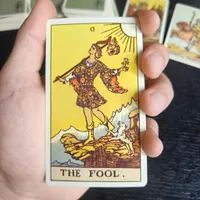

The short answer: the Celtic Cross is a 10-card tarot spread that gives a full picture of a situation. Six cards form a cross (the heart of the matter and what crosses it, surrounded by the root, the recent past, the conscious goal and the near future), and four cards form a vertical “staff” beside it (yourself, your surroundings, your hopes and fears, and the likely outcome). It was popularised by Arthur Edward Waite in The Pictorial Key to the Tarot (1910), the companion book to the Rider–Waite–Smith deck, and it’s still the best-known spread in tarot. Use it for complex questions with several moving parts; for one simple question, a three-card spread is faster.
| # | Position | What it shows |
|---|---|---|
| 1 | The Present / Heart of the Matter | Where you are now; the core of the question |
| 2 | The Challenge (laid across card 1) | What crosses you: the obstacle or the force to work with |
| 3 | The Foundation / Root | The underlying cause; what’s beneath the situation |
| 4 | The Recent Past | What’s just happened and is now passing |
| 5 | The Crown / Conscious Goal | What you’re aiming for; the best that can be achieved |
| 6 | The Near Future | What’s coming in the next weeks or months |
| 7 | You / Your Attitude | How you’re approaching the situation |
| 8 | External Influences | Other people, environment, circumstances |
| 9 | Hopes and Fears | What you hope for, or fear (often both at once) |
| 10 | The Outcome | Where things are heading on the current path |
How to Lay Out the Celtic Cross
              [5]                 [10]

      [4]   [1][2]   [6]          [9]

              [3]                 [8]

[7]- Place card 1 in the centre.
- Lay card 2 across card 1, sideways.
- Card 3 goes below the centre, card 4 to the left, card 5 above, card 6 to the right, forming the cross.
- Lay cards 7 to 10 in a column to the right, from the bottom up: 7 at the bottom, 10 at the top.
Some readers place card 4 to the right and card 6 to the left, or the recent past according to which way the figure on card 1 faces. Any consistent method works; choose one and stick with it.
The 10 Positions in Depth
The Cross: the situation itself
1. The Present. The centre of everything: your situation as it is right now. Read the other nine cards in relation to this one.
2. The Challenge. What crosses you. Traditionally it’s always read upright as the obstacle, but it isn’t always negative: a positive card here (the Sun, say) can show a strength you need to use, or something good that’s complicating things.
3. The Foundation. The root of the matter, often something below the surface: a past event, a belief, an unconscious need.
4. The Recent Past. What has just happened and is fading in influence.
5. The Crown. Your conscious goal, or the best outcome available. Compare it with card 3: the gap between what’s underneath (3) and what you’re reaching for (5) is often revealing.
6. The Near Future. The next chapter, usually the coming weeks or few months.
The Staff: you and the wider world
7. You. Your attitude, how you see yourself in this situation, and the energy you bring.
8. External Influences. The people around you, your environment, and how others see you.
9. Hopes and Fears. What you hope for or fear. Because we often fear what we most want, this card can be both. Ask: “Is this a hope, a fear, or both?”
10. The Outcome. The likely result if things continue as they are. Read it as a direction, not a verdict: the other nine cards show where you can make a difference.
How to Read the Celtic Cross: Read It in Pairs
The spread is easiest to read as five conversations between pairs of cards:
| Pair | Cards | The question it answers |
|---|---|---|
| Heart and challenge | 1 + 2 | What’s the situation, and what’s complicating it? |
| Root and crown | 3 + 5 | What’s driving this underneath, and what am I aiming for? |
| Past and future | 4 + 6 | Where has this come from, and where is it going next? |
| Inner and outer | 7 + 8 | How am I showing up, and how is the world responding? |
| Hope and outcome | 9 + 10 | What do I want or fear, and where is it actually heading? |
Then step back and look at the whole spread:
- Count the Major Arcana. Four or more suggests a significant, fated-feeling chapter of life.
- Note the dominant suit. Cups: emotions and relationships; Pentacles: money, work, home; Swords: thoughts, decisions, conflict; Wands: energy, ambition, creativity.
- Look for court cards. They often represent real people involved, or roles you’re playing.
- Notice reversals. Several reversed cards can point to delays or energy turned inward.
- Compare card 10 with card 5. If the outcome matches your conscious goal, you’re on track; if not, the staff (7–9) shows what could shift it.
Celtic Cross Love Reading: Positions and a Worked Example
The Celtic Cross works beautifully for love because it separates what you feel from what is happening between you. For a love question, read the positions like this:
| # | Standard position | In a love reading |
|---|---|---|
| 1 | Present | The relationship as it is now |
| 2 | Challenge | What is testing the connection |
| 3 | Foundation | What the bond is built on, including old patterns |
| 4 | Recent past | The event that brought you to this question |
| 5 | Crown | What you want this relationship to become |
| 6 | Near future | The next development, in the coming weeks |
| 7 | You | How you are showing up in the relationship |
| 8 | External | The other person, or the people and pressures around you |
| 9 | Hopes and fears | What you hope for and quietly fear |
| 10 | Outcome | Where things are heading if nothing changes |
If you are single, swap position 8 for “the kind of partner coming in” and read position 10 as the outcome of your love life over the next few months. For shorter love questions, try a love tarot spread or a five-card tarot spread.
Question: “Where is my relationship with Alex heading?”
| # | Position | Card | Reading |
|---|---|---|---|
| 1 | Present | Two of Cups | A real, mutual connection |
| 2 | Challenge | Five of Swords | Unresolved arguments: someone always wants to “win” |
| 3 | Foundation | Six of Cups | Old patterns from past relationships or childhood |
| 4 | Recent past | Three of Swords | A recent hurt or painful conversation |
| 5 | Crown | Ten of Cups | You want a loving, lasting family life |
| 6 | Near future | Temperance | Balance and compromise are coming |
| 7 | You | Queen of Cups | Caring, intuitive, emotionally generous |
| 8 | External | Knight of Wands | Alex is passionate but restless |
| 9 | Hopes and fears | The Lovers | You hope this is “the one” and fear it isn’t |
| 10 | Outcome | Ace of Cups | A fresh emotional start: renewed love |
The story: the connection is real (1), but recent hurt (4) and old patterns (3) have turned conversations into contests (2). You want something lasting (5), you’re bringing warmth (7), and Alex brings passion but some restlessness (8). The near future brings balance and compromise (6), and the outcome is a fresh emotional start (10). The message: let go of “winning” arguments, and this relationship has every chance of renewing itself.
Common Variations
- Waite’s original wording: positions like “what covers him”, “what crosses him”, “what crowns him”, “what is beneath him”, “what is behind him” and “what is before him”, with cards 7–10 as “himself”, “his house”, “his hopes or fears” and “what will come”.
- The significator: some readers first choose a card to represent the querent (often a court card) and place it under card 1.
- Card 5 as “possible future” and card 6 as “near future”: used by some readers.
- Clarifier cards: draw an extra card for any position that feels unclear.
Celtic Cross or a Smaller Spread?
| Choose the Celtic Cross when… | Choose a smaller spread when… |
|---|---|
| The situation is complex, with history and other people | You have one clear question |
| You want to understand why, not just what | You want a quick yes-or-no or daily guidance |
| You have 20–40 minutes | You have a few minutes |
Getting a Celtic Cross Reading
Ten cards take time and experience to weave into one story, which is why many people book a Celtic Cross with a reader. Online, a Celtic Cross usually takes 20 to 40 minutes; at the $4.99/min median that’s about $100–$200 at standard rates, or much less as a first reading with a welcome offer (tarot reading prices). Tarot readers we’ve reviewed who work in depth:
- A Divine Spirit (Kasamba): readings built on the full Major and Minor Arcana; 46,731 readings with a 99.5% approval ratio.
- Golden Eye (Kasamba, $4.99/min chat): tarot, astrology and dreams; 113,722 readings since 2004.
- Truelovetarot (Purple Garden, $6.99/min chat): love and specific-person spreads with a perfect 5.0.
- Tarot With Meg (Keen, $4.75/min): Rider–Waite–Smith deck; explains the “why” behind a situation.
More: best online tarot reading sites.
Frequently Asked Questions
What is the Celtic Cross tarot spread?
A 10-card spread that gives a full picture of a situation: six cards in a cross (present, challenge, foundation, recent past, goal, near future) and four in a column (self, external influences, hopes and fears, outcome). It was popularised by A. E. Waite in 1910.
What are the 10 positions of the Celtic Cross?
1 the present, 2 the challenge, 3 the foundation, 4 the recent past, 5 the crown or conscious goal, 6 the near future, 7 you, 8 external influences, 9 hopes and fears, 10 the outcome.
How do you read a Celtic Cross spread?
Read it in pairs: heart and challenge (1–2), root and crown (3–5), past and future (4–6), inner and outer (7–8), and hopes and outcome (9–10). Then look at the whole spread for patterns such as several Major Arcana, a dominant suit or court cards.
Is the Celtic Cross good for beginners?
It’s a great spread to learn once you know the basic card meanings. Many beginners start with three-card spreads and move to the Celtic Cross as they gain confidence.
What does the crossing card mean in the Celtic Cross?
Card 2, laid across card 1, is the challenge: what’s crossing or complicating your situation. Traditionally it’s read upright; a positive card here can show a strength to use or a good thing that’s complicating matters.
How long does a Celtic Cross reading take?
Usually 20 to 40 minutes, depending on how deeply each card is explored.
Related Guides
- Three-card tarot spreads
- Love tarot spreads
- How to read tarot cards
- Tarot card meanings for beginners
- Lenormand vs tarot
The eight best tarot and card readers on Keen in 2026, chosen from our audit of 49 Keen advisors: what each reader's method is, what they cost with Keen's 5-minutes-for-$1 offer, and which one fits your question.
Read the guide →Still weighing it up? The fastest way to know if a reading clicks is to try one — 3 free minutes + 50% off for new clients.
Free to join · 3 free minutes on your first reading · No subscription
Ready to get your reading?
Pick the one that fits your question — every link is an independent recommendation.
3 free minutes + 50% off
Permanent chat transcripts & 3 free minutes on your first reading — safest for testing relationship specialists.
Claim 3 Free Min + 50% Off →Claim 3 Free Min →
$30 free credit
Mandatory video intros & a public outcomes ledger. The most accessible entry price.
Claim $30 Credit →Claim $30 Credit →
5 free minutes
Your first 5 minutes are credited back after the first reading, and a disappointing session can earn up to 10 minutes back.
Claim 5 Free Min →Claim 5 Free Min →Eastern Alignment is reader-supported. If you sign up through a link, we may earn a commission — at no extra cost to you. This never influences my ratings.