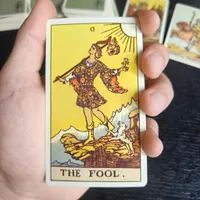

The short answer: fortune telling is the practice of seeking insight into a person’s life and future through a method of divination: reading tarot cards, a birth chart, the lines of a palm, numbers, tea leaves and more. A fortune teller uses that method as a framework for a conversation about your question: love, work, a decision, what’s coming next. Today most people get their fortunes told online, by chat, phone or video with readers who specialise in one method. About 30% of Americans consult astrology, tarot cards or a fortune teller at least once a year (Pew Research Center, 2025).
| Method | What’s read | Best for | Online? |
|---|---|---|---|
| Tarot | 78 picture cards in a spread | Love, decisions, “what’s coming” | Yes, the most popular online method |
| Astrology | Your birth chart and current transits | Personality, timing, compatibility | Yes |
| Palmistry | Lines, mounts and shape of the hand | Character, life themes | Yes, by video or photo |
| Numerology | Numbers from your birth date and name | Life path, personal year timing | Yes |
| Lenormand | 36 cards read in pairs and lines | Concrete, everyday predictions | Yes |
| Tea leaves (tasseography) | Shapes left in a cup | A playful, symbolic reading | Rarely |
| Coffee grounds | Patterns in a Turkish coffee cup | Love, travel, news | Rarely |
| I Ching | Hexagrams from coins or yarrow stalks | Advice for a decision | Yes |
| Runes | Norse letters cast or drawn | Guidance, a single answer | Some readers |
| Scrying | A crystal ball, mirror or water | Intuitive impressions | Some readers |
| Chinese fortune sticks (kau cim) | A numbered stick shaken from a cup | A specific question at a temple | Rarely |
| Birthday systems | Your birth date through numbers, cards or the zodiac | Your “birth” themes | Yes |
What Is Fortune Telling?
Fortune telling is one of the oldest human practices: people in every culture have looked for signs about what’s ahead, from the oracle at Delphi to Chinese oracle bones. What unites all methods is a system of symbols (cards, stars, numbers, lines, shapes) and a reader who interprets those symbols for a person’s question.
In practice, a modern fortune telling session is less about announcing a fixed future and more about clarity: seeing a situation from a new angle, naming what you feel, and considering the likely outcome of the path you’re on. That’s why good readers ask for a clear question and give advice as well as predictions.
The 12 Main Methods of Fortune Telling
1. Tarot
Tarot fortune telling uses a 78-card deck: 22 Major Arcana cards for life’s big themes and 56 Minor Arcana cards in four suits for everyday matters. The reader lays cards in a spread, where each position has a meaning (past, present, future; you, them, the relationship), and reads them as a story. Tarot is the most popular method online because it handles almost any question and works well by chat, phone or video.
Learn more: tarot card meanings for beginners, three-card tarot spreads and best online tarot reading sites.
2. Astrology
An astrologer reads your birth chart, a map of where the sun, moon and planets were at the moment you were born, and the transits moving through it now. Astrology is strongest for personality, timing (“when is a good time to…?”) and compatibility. See how to read your birth chart and the best astrology readers online.
3. Palmistry
Palm reading interprets the heart, head, life and fate lines, the mounts at the base of the fingers and the shape of the hand. It’s a reading of character and life themes more than dates. Online, palm readers work from a video call or clear photos. See our palm reading beginner’s guide.
4. Numerology
Numerology reduces your birth date and birth name to core numbers, above all the Life Path number, and reads their meanings, plus a Personal Year number for timing. See our numerology reading guide and the Pythagorean numerology chart.
5. Lenormand
A 36-card deck named after the famous Parisian fortune teller Marie Anne Lenormand, read in pairs and lines like sentences. Lenormand is known for concrete, everyday answers (“a letter about money”, “a short trip”). See Lenormand vs tarot.
6. Tea-leaf reading (tasseography)
After drinking loose-leaf tea, the reader swirls the cup, turns it over and reads the shapes left by the leaves: a ring for a commitment, a bird for news. Hugely popular in Victorian Britain, it’s now a gentle, symbolic practice more often done at home than booked.
7. Coffee-ground reading
The Turkish and Middle Eastern counterpart: after a cup of thick Turkish coffee, the cup is turned onto its saucer to cool and the patterns in the grounds are read for love, travel and news. It’s traditionally a social ritual among friends and family.
8. The I Ching
The I Ching (Book of Changes) is a Chinese classic around 3,000 years old. You toss three coins six times (or divide yarrow stalks) to build one of 64 hexagrams, each with a text of advice. It’s less a prediction than wise counsel for a decision.
9. Runes
Runes are letters of the old Germanic alphabets, usually the 24 runes of the Elder Futhark, carved on stones or wood. Modern rune casting, popularised in the 1980s, draws one or three runes for guidance on a question.
10. Scrying (crystal ball)
Scrying means gazing into a reflective surface (a crystal ball, a black mirror or still water) until images or impressions arise. The Elizabethan scholar John Dee famously used a polished obsidian “shew-stone”. It’s the most purely intuitive method on this list.
11. Chinese fortune sticks (kau cim)
At temples across China, Hong Kong and Taiwan, a person kneels, asks a question and shakes a cylinder of numbered bamboo sticks until one falls out. The number matches a poem that a temple interpreter explains. Hong Kong’s Wong Tai Sin Temple is famous for it.
12. Birthday fortune telling
Several systems read your birth date on its own: your numerology Life Path, your Western sun sign, your Chinese zodiac animal, the Chinese Four Pillars (BaZi) based on the year, month, day and hour of birth, and a playing-card system that assigns each birthday one of the 52 cards. Birthday readings are a popular gift and a gentle introduction to fortune telling.
A Short History of Fortune Telling With Cards
Playing cards reached Europe in the late 14th century, and tarot began in 15th-century Italy as a card game (tarocchi), not a fortune-telling tool. Reading ordinary playing cards for fortunes (cartomancy) grew popular in the 1700s. In the 1780s, the Parisian occultist Jean-Baptiste Alliette, writing as Etteilla, published the first tarot deck designed specifically for divination. A century later, the Hermetic Order of the Golden Dawn linked tarot with astrology and the Kabbalah, and in 1909 A. E. Waite and the artist Pamela Colman Smith created the Rider-Waite-Smith deck, whose fully illustrated cards are the basis of most decks used today.
What Does a Fortune Teller Actually Do in a Reading?
A typical session, in person or online, follows the same shape:
- You share your question, often with first names and a little context.
- The reader uses their method: lays the cards, opens your chart, studies your palm.
- They interpret the symbols for your question: what’s happening, what’s influencing it, where it’s heading.
- You talk it through. Good readers check what resonates and answer follow-up questions.
- They offer advice: what to watch for, what to do next, sometimes a likely timeframe.
What makes a fortune teller good is not the method but the reader: their experience, honesty, and ability to turn symbols into something you can use. That’s why it pays to choose a reader with a long, public track record.
What Fortune Telling Can and Can’t Do
Fortune telling is at its best as a tool for reflection and guidance. People come away with:
- Clarity about how they really feel and what they want.
- A fresh perspective on a relationship, decision or crossroads.
- A sense of timing and possibilities to prepare for.
- Comfort and encouragement during an uncertain stretch.
Readers describe likely paths and possibilities rather than a fixed future, and your own choices remain the biggest influence on what happens. For anything medical, legal or financial, use a fortune telling session alongside, not instead of, professional advice. Many readers say the same thing themselves.
Is Fortune Telling Legal?
In most places, yes. Online reading platforms operate legally across the United States and many other countries. A few U.S. states and cities have old laws regulating fortune telling for money, most famously New York, which is why many readers describe their services as being “for entertainment”. Several of those laws have been struck down or repealed in recent decades. Our guide to whether fortune telling is illegal covers the details state by state.
How to Find an Online Fortune Teller Who Delivers
The phrase people search most is “an online fortune teller that works”. The readers who deliver tend to share the same traits:
| Look for | Why it matters | Where to check |
|---|---|---|
| A long, public track record | Thousands of completed readings and years on a platform show consistency | The reading count and “member since” on the profile |
| A method that fits your question | Tarot for love and decisions, astrology for timing, mediums for loved ones | The reader’s listed specialties |
| Recent written reviews | Clients describe what was accurate and how it felt | The review feed, newest first |
| Clear per-minute pricing | You know what a reading will cost before you start | The profile rate (chat and voice can differ) |
| A satisfaction guarantee | A credit if a first reading doesn’t connect | Kasamba and Purple Garden: up to $50 credit on a first session with a new advisor; Keen: up to $25 within 72 hours |
What it costs: online fortune tellers typically charge $3 to $8 a minute; the median in our 242-advisor audit is $4.99/min. Welcome offers make a first reading much cheaper: 3 free minutes then 50% off on Kasamba, a $30 credit on Purple Garden, or 5 minutes for $1 on Keen. A focused 15-minute first reading at $4.99 costs $29.94 on Kasamba, $44.85 on Purple Garden and $50.90 on Keen. Full details: how much a psychic reading costs.
Fortune tellers we’ve reviewed, by method
- Tarot: Miss Bathsheba (Kasamba, $4.99/min): a second-generation tarot specialist with 71,618 readings since 2006.
- Astrology: Melodie (Kasamba, $9.99/min): relationship and life-path charts from a member of three astrology associations, reading on Kasamba since 2001.
- Numerology: Psychic Logan (Purple Garden, $4.99/min): life path and destiny questions, 64,955 readings.
- Many methods in one: Golden Eye (Kasamba, $4.99/min chat): tarot, astrology, numerology and dream work across 113,722 readings since 2004.
- Straight predictions: Krys Britton (Keen, $2.25/min): concrete answers with Egyptian oracle cards from 49,000+ readings.
For a broader ranking, see psychic readings online and legit psychic sites.
Frequently Asked Questions
What is fortune telling?
The practice of seeking insight into a person’s life and future through a method of divination, such as tarot cards, astrology, palmistry, numerology or tea leaves. A fortune teller interprets the symbols of that method for your question.
What are the most common types of fortune telling?
Tarot, astrology, palmistry and numerology are the most common, followed by Lenormand cards, tea-leaf and coffee-ground reading, the I Ching, runes, crystal-ball scrying, Chinese fortune sticks and birthday systems.
What is tarot fortune telling?
Using a 78-card tarot deck to answer a question: the reader lays cards in a spread where each position has a meaning, then reads the cards together as a story. It’s the most popular form of fortune telling online.
How do I find an online fortune teller that works?
Choose a reader with a long public track record (thousands of readings), recent written reviews, a method that fits your question and clear per-minute pricing, on a platform with a satisfaction guarantee. Use a welcome offer to try a reader before committing to a long session.
How much does a fortune teller cost?
Online, typically $3 to $8 a minute, with a median of $4.99/min across the 242 advisors we audit. A 15-minute first reading at that rate costs about $30 to $51 with welcome offers. In person, a session usually costs $70 to $160.
Is fortune telling legal?
In most places, yes, and online reading platforms operate legally in the U.S. A few states and cities have old laws on fortune telling for money, which is why many readers describe their services as for entertainment.
What is birthday fortune telling?
Reading your character and themes from your birth date alone, through your numerology Life Path, sun sign, Chinese zodiac animal, Chinese Four Pillars (BaZi) or a playing-card birth card.
How many people get their fortune told?
About 30% of Americans consult astrology, tarot cards or a fortune teller at least once a year, according to the Pew Research Center (2025). More statistics are in our psychic industry statistics.
Related Guides
- What is a psychic reading?
- Psychic vs tarot vs astrology: which reading to choose
- Tarot card meanings for beginners
- Is fortune telling illegal?
- Psychic readings online
- What to expect from your first psychic reading
Tired of paying for fairy tales? We audited the Keen platform to find the 4 most ruthlessly honest psychics who will tell you the painful truth, even if it costs them a 5-star review.
Read the guide →Still weighing it up? The fastest way to know if a reading clicks is to try one — 3 free minutes + 50% off for new clients.
Free to join · 3 free minutes on your first reading · No subscription
Ready to get your reading?
Pick the one that fits your question — every link is an independent recommendation.
3 free minutes + 50% off
Permanent chat transcripts & 3 free minutes on your first reading — safest for testing relationship specialists.
Claim 3 Free Min + 50% Off →Claim 3 Free Min →
$30 free credit
Mandatory video intros & a public outcomes ledger. The most accessible entry price.
Claim $30 Credit →Claim $30 Credit →
5 free minutes
Your first 5 minutes are credited back after the first reading, and a disappointing session can earn up to 10 minutes back.
Claim 5 Free Min →Claim 5 Free Min →Eastern Alignment is reader-supported. If you sign up through a link, we may earn a commission — at no extra cost to you. This never influences my ratings.